Symposium Honors Virginia Lee’s Legacy in Neurodegeneration Research
InFocus • Fall 2025 Issue • November 30, 2025
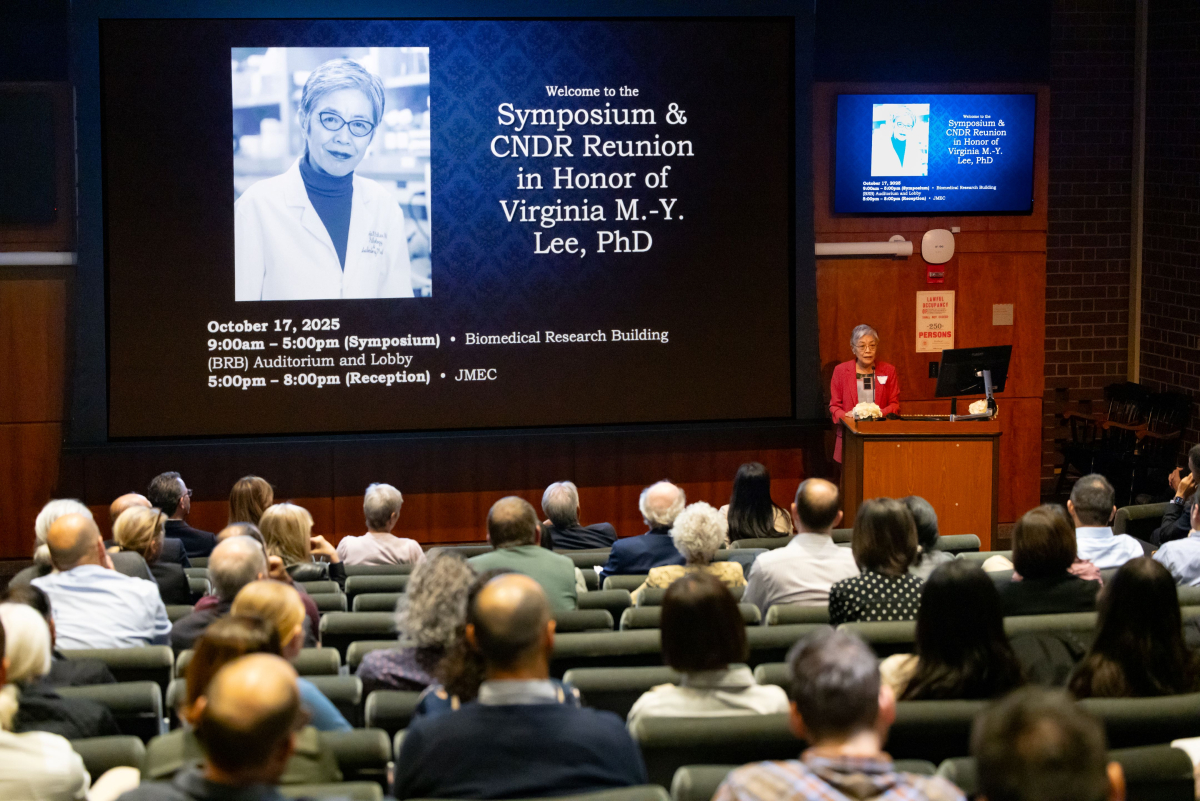
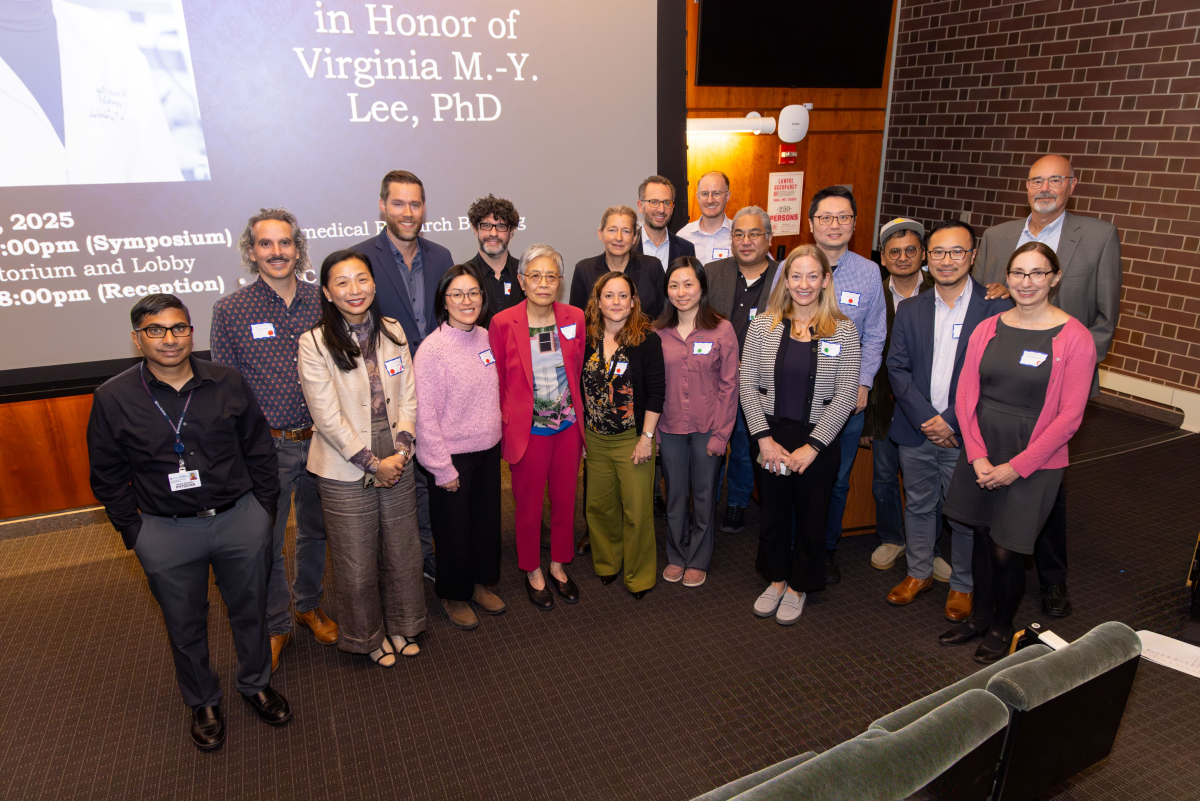
 On Friday, October 17, 2025, over 50 former trainees gathered with colleagues, friends, and family to honor Virginia M.Y. Lee, the John H. Ware III Endowed Professor in Alzheimer’s Research, at a daylong symposium held in the Biomedical Research Building. Trainee speakers highlighted the scientific eras of Dr. Lee’s storied career, which has included foundational discoveries on the role of multiple disease proteins in neurodegeneration. Together with her husband and scientific collaborator, the late John Q. Trojanowski, Dr. Lee discovered in the 1990s that neurofibrillary tangles found in the brains of individuals with Alzheimer’s disease were composed of an abnormally phosphorylated form of the protein tau. This discovery was followed by their 2000’s discovery that a protein named TDP-43 was the building block of the disease-defining ubiquitinated inclusions of frontotemporal dementia and amyotrophic lateral sclerosis. The 2010s saw Dr. Lee’s research group demonstrating that the cell-to-cell transmission of alpha-synuclein pathology was possible and might in fact underlie the progression of Parkinson’s disease.
Accordingly, the October symposium featured talks on tau, TDP-43, and alpha-synuclein, given by the trainees who made these, and many other, discoveries in Dr. Lee’s lab. Trainees from 5 continents shared the indelible impact Dr. Lee has had on their careers and spoke about their current research findings. Laura Volpicelli-Daley, a late 2000s trainee who is now Professor of Neurology at the University of Alabama Birmingham, captured the sentiments of many when she confessed that although “it’s been 13 years since I’ve been in your lab, Virginia, I still feel like I need to show you data,” before sharing work from her own laboratory on the role of alpha-synuclein at the synapse. Dr. Lee’s intensity and investment in her trainees was echoed by Dan Skovronsky, a 1990s graduate student who is now CSO of Eli Lilly, who commented, “A couple of people had told me that the hardest lab to be a graduate student in was Virginia Lee’s lab… [but] thanks, Virginia, for believing in us, that’s probably the most important thing a mentor can do.” The excitement of working with Dr. Lee was also a frequent theme among speakers: Adam Walker, a 2010s trainee who is now Professor and Chair of Pharmacology at the University of Sydney, recounted his attending a conference in 2006 where “Virginia got up, and she gave the most exciting talk on a random protein that no one had ever paid much attention to,” prompting him to move from Tasmania to Philadelphia to study that protein, TDP-43.
The symposium was followed by a reception in the Jordan Medical Education Center, where the toasts (and roasts) continued. The last toast of the evening, from David Irwin, Associate Professor of Neurology at Penn, captured the spirit of the day: “Being a trainee at CNDR, everything is possible.”
Talks from the Virginia M.Y. Lee Symposium can be viewed at this link:
https://mediasite.med.upenn.edu/mediasite/Channel/symposium-honoring-virginia-lee
See more photos from the event here
- Authored by Dr. Alice Chen-Plotkin